
Does hyperbolic tapering work? What 608 patients showed
In a prospective Dutch study, 608 patients tapering antidepressants in tiny daily steps rated their withdrawal every day. It stayed low and rose and fell with the speed of the taper, which says a lot about how to run one.
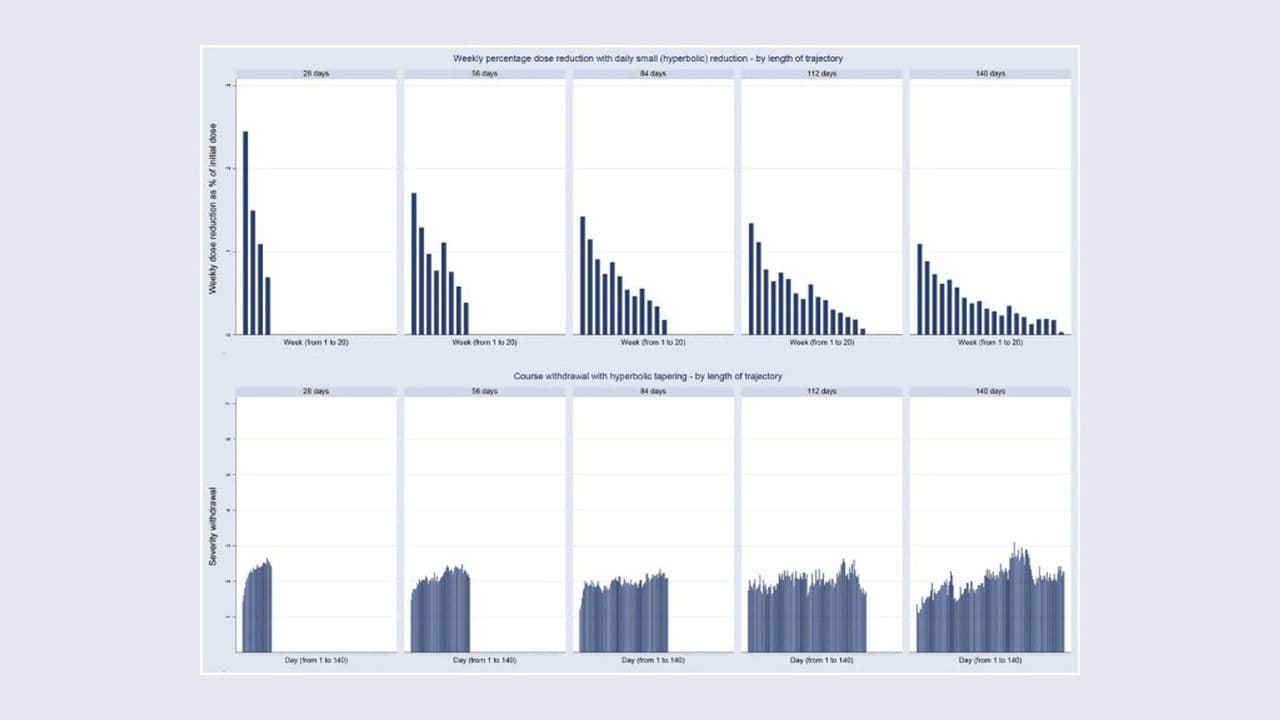
On the best evidence so far, yes. In a 2023 study of 608 Dutch patients coming off antidepressants in very small daily steps, withdrawal stayed low on average, between "very little" and "a little". More than half of them had already tried to stop at least once and failed.
The study, by Jim van Os and Peter Groot in Therapeutic Advances in Psychopharmacology, tracked withdrawal day by day through the taper. It follows on from the guideline gap we wrote about earlier: guidelines say to taper gradually without saying how, and this is data on one way of doing it.
Key points
- Withdrawal stayed low: on average, patients rated it between "very little" and "a little".
- Speed matters most: the faster the dose came down, the more withdrawal patients had. The authors think this is likely cause and effect.
- No one-size-fits-all timeline: the length of each taper was set with the patient, and slowed or paused when withdrawal rose.
- Most patients were at risk: women, younger patients and those with more risk factors had more withdrawal. But 94% had at least one risk factor, so risk factors cannot sort patients into those who need a careful taper and those who do not.
- The last steps take longest: the final 10% to 15% of a dose can take longer to come off than the first 85%.
What is hyperbolic tapering?
It means making each dose cut smaller than the last. At low doses, each milligram of an antidepressant does proportionally more, so a 5 mg cut near the end of a taper removes far more of the drug's effect than a 5 mg cut at the start. Shrinking the steps keeps the reduction in effect steady.
Standard tablets do not come in the tiny doses the final steps need. In the Netherlands, tapering strips solve this: a roll of numbered daily pouches, each the same as or slightly lower than the day before. Stabilisation strips hold a patient on one dose when withdrawal appears.
Who was in the study?
Between 2019 and 2022, 608 people prescribed tapering strips rated their withdrawal every day on a scale from 1 (not at all) to 7 (very much). Most were women (81%), with an average age of about 53. Most (81%) had taken antidepressants for more than two years, and the most common drugs were venlafaxine (41%) and paroxetine (24%).
Does the speed of the taper matter?
Yes, and it is the study's main finding. Withdrawal was "an approximate mirror-image of the rate of dose reduction". Patients who tapered fastest, over 28 days, saw a rapid rise in withdrawal, and each slower schedule was linked to less.
A small comparison group pointed the same way. Patients cutting their dose once a week, by about a third each time, had more withdrawal than those cutting a little every day. Only 51 patients were in the weekly group, so the authors treat that result with caution.
What does it mean for how a taper is run?
The authors put it plainly: "There can be no prescribed trajectory length that will be valid for all." Each schedule was agreed between patient and prescriber, and the daily ratings existed so it could be slowed or paused when withdrawal rose. Pausing was part of the method, not a sign the taper had failed. A full taper can also run well past the two to five months the study observed.
What are the study's limits?
It is an observational study, and only 16% of the people who received strips returned their daily ratings, though they looked broadly similar to those who did not. The reason each patient was taking an antidepressant was not recorded. Peter Groot was involved in developing tapering strips and both authors research them; the paper states that neither is involved in producing or selling them.
Where Prescriby fits
The study's lesson does not depend on tapering strips: small steps sized to the dose, with the schedule adjusted week by week against what the patient reports. That is how we work. When a provider refers a patient to us, we take over prescribing the antidepressant being reduced, write a step-by-step dose schedule and see the patient every one to four weeks, with symptom tracking in between. If a step brings on symptoms, we pause or make the next one smaller.
That tracking is what makes withdrawal visible as a response to a specific dose change, rather than something pieced together months later.
Our page on tapering SSRIs and SNRIs covers the class in more detail: generic and brand names, what withdrawal feels like, and how the schedule is written.
Refer a patient, or ask us first: what we can and cannot do for a referred patient.
The source
van Os J, Groot PC. Outcomes of hyperbolic tapering of antidepressants. Ther Adv Psychopharmacol. 2023;13:20451253231171518. doi:10.1177/20451253231171518. PMID 37200818. Read the full paper on PubMed Central.
Header image: Figure 5 from van Os and Groot (2023), showing weekly dose reduction (top) and daily withdrawal ratings (bottom) by length of taper. Reproduced under a CC BY 4.0 licence and placed on a wider background.