
Z-drugs and driving: how long does impairment last?
Some Z-drugs impair driving the morning after a bedtime dose, and patients can be impaired while feeling fully awake. What the evidence shows for zolpidem, eszopiclone and zaleplon, and what to tell patients.
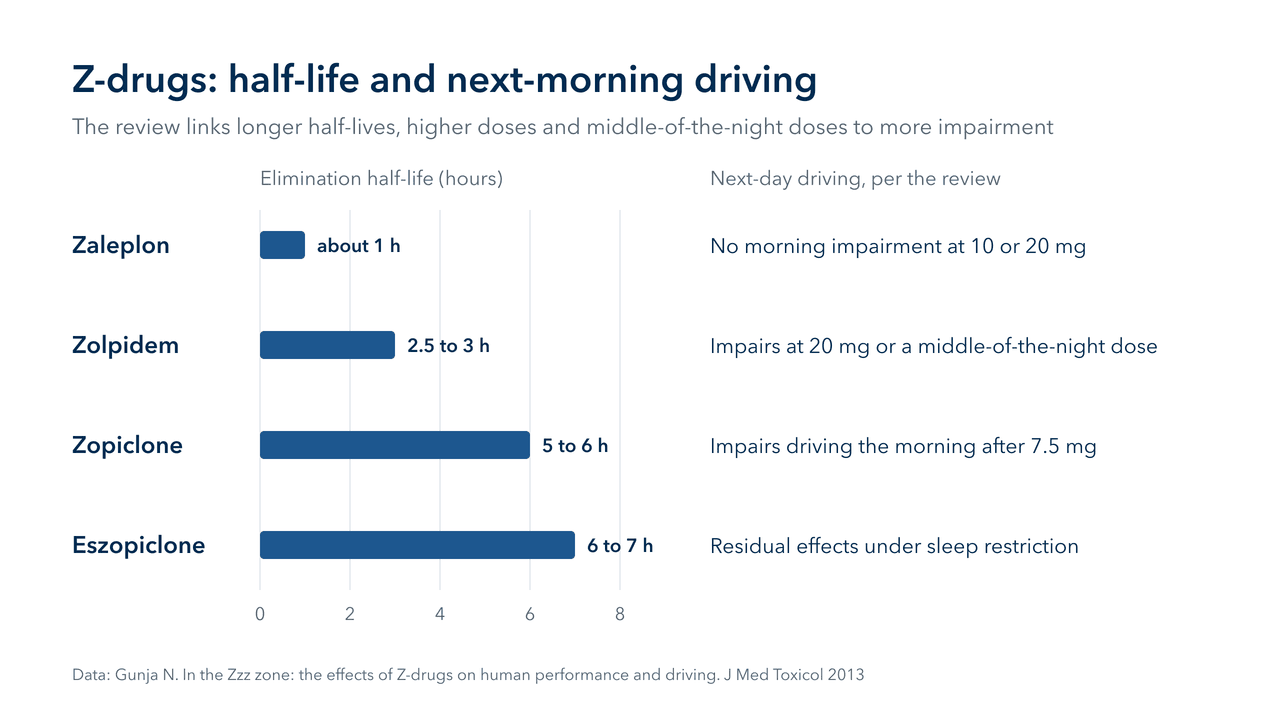
Yes, a Z-drug sleeping pill can affect driving the next morning, even when the person feels fully awake. How long the effect lasts depends on which drug it is, the dose, when it was taken and who took it. That is the conclusion of a 2013 review by medical toxicologist Naren Gunja, and two later FDA actions point the same way.
Key points
- Double the crash risk: in population studies, people taking Z-drugs had roughly twice the risk of a car crash.
- Some last into the morning: zopiclone, and zolpidem at higher doses or taken in the middle of the night, impaired driving the next day. Zaleplon, the shortest-acting, was unlikely to after four hours.
- Feeling awake is not enough: the FDA warns that people can be impaired the morning after even if they feel fully alert.
- Years of use do not make it safe: there is early evidence that the body may not get used to the impairment, even with nightly use.
- Women and older adults are most affected, as is anyone combining a sleeping pill with alcohol or other sedatives.
What are Z-drugs?
Z-drugs are a group of prescription sleeping pills: zolpidem (Ambien), eszopiclone (Lunesta), zaleplon (Sonata) and zopiclone. Zopiclone is not sold in the United States, but eszopiclone is its active form, so research on zopiclone still applies to US patients.
How much do they raise crash risk?
In a Norwegian study, people taking zolpidem or zopiclone had more than twice the risk of a road crash of people who took neither. A UK study of drivers in a first crash found a 62% higher risk for sedatives including zopiclone. A French study found no extra risk from zopiclone, so the evidence is not uniform.
Which ones last into the next morning?
It depends mostly on how long the drug stays in the body. On-road tests that measure how much a car weaves within its lane show a clear pattern:
- Zopiclone: the most consistent next-morning effect. Ten to eleven hours after a 7.5 mg dose, lane weaving was twice as bad as at a blood alcohol level of 0.03%. A 15 mg dose affected driving for up to 16 hours.
- Eszopiclone: no effect after a full night's sleep in one study, but a clear next-day effect when sleep was cut short.
- Zolpidem: little effect the morning after 10 mg in healthy adults. At 20 mg, or taken in the middle of the night, it impaired daytime driving, and in drivers aged 55 to 65 the effect lasted 10 hours after a 10 mg dose.
- Zaleplon: the shortest-acting. No effect the next morning, and a middle-of-the-night dose appears safe if at least four hours pass before driving.
Who is most at risk?
- Women taking zolpidem. Women clear zolpidem more slowly than men, so in 2013 the FDA halved the recommended dose for women and asked prescribers to consider the lower dose for men too. The risk is highest with extended-release zolpidem.
- Older adults. The effect lasts longer, and it adds to the risk of falls and hip fractures.
- Anyone taking a higher dose, or dosing in the middle of the night, because less time passes before the morning drive.
- Anyone combining a Z-drug with alcohol or other sedatives.
Is sleep-driving the same thing?
No. Sleep-driving means driving while not fully awake, with no memory of it afterwards. In 2019 the FDA added a boxed warning, its strongest kind of warning, to eszopiclone, zaleplon and zolpidem after such episodes led to serious injuries and deaths. Anyone who has one should stop the medicine and not be prescribed any of the three again.
What should patients be told?
Gunja advises giving patients a minimum wait before they drive. A driving-safety classification cited in the review suggests about 10 hours after 10 mg of zolpidem and 5 hours after 10 mg of zaleplon, and puts zopiclone in the highest-risk group.
It is also worth asking whether a nightly sleeping pill is still the right treatment. Guidance puts cognitive behavioral therapy for insomnia, not medication, first for long-term insomnia, and the labels describe short-term use. For older adults, the review found harms outweighed benefits: for every 13 treated, one more slept better, but for every 6 treated, one more had a side effect.
Where Prescriby fits
Stopping a long-term Z-drug suddenly usually brings several nights of rebound insomnia, the main reason unplanned attempts fail. A planned taper gets the patient through it. When a provider refers a patient to us, we take over prescribing the sleep medication, write a step-by-step dose schedule and see the patient every one to four weeks, with symptom tracking in between. If a step is too hard, we pause or make the next one smaller.
Our page on tapering sleep medications covers zolpidem, eszopiclone and zaleplon in more detail, including what rebound insomnia and withdrawal feel like.
Refer a patient, or ask us first: what we can and cannot do for a referred patient.
The sources
Gunja N. In the Zzz zone: the effects of Z-drugs on human performance and driving. J Med Toxicol. 2013;9(2):163-171. doi:10.1007/s13181-013-0294-y. PMID 23456542. Read the full paper on PubMed Central.
US Food and Drug Administration. Questions and answers: risk of next-morning impairment after use of insomnia drugs; FDA requires lower recommended doses for certain drugs containing zolpidem. January 2013. Read it on fda.gov.
US Food and Drug Administration. Certain prescription insomnia medicines: new boxed warning due to risk of serious injuries caused by sleepwalking, sleep driving and engaging in other activities while not fully awake. 30 April 2019. Read it on fda.gov.