
Gabapentin and dementia risk: what the 2025 study found
A 2025 study of US adults with chronic low back pain linked repeated gabapentin prescriptions to more dementia and mild cognitive impairment. It cannot prove cause, but it is a good reason to review the prescription.
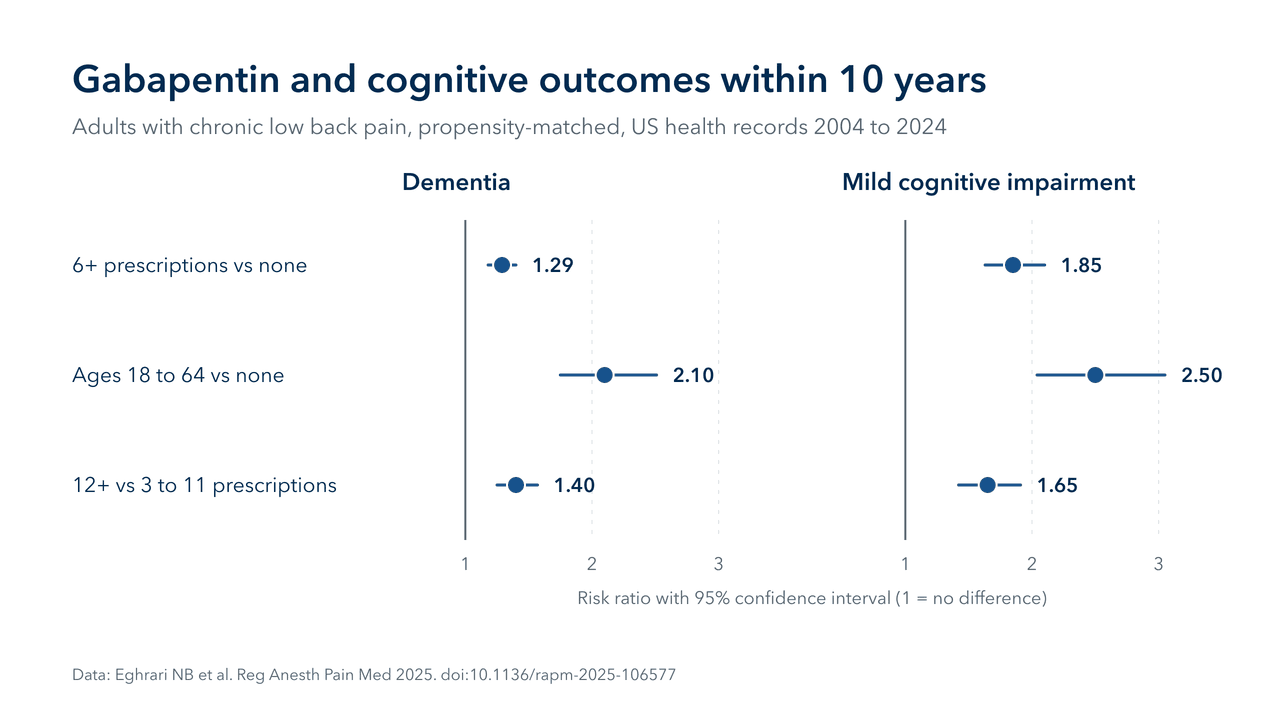
A large 2025 study found that adults with long-term low back pain who were prescribed gabapentin again and again were more likely to be diagnosed with dementia or with early memory and thinking problems over the next ten years. It does not prove that gabapentin caused them. It is still a good reason to check whether a long-running prescription is still needed.
Key points
- Six or more prescriptions: adults with back pain who received six or more gabapentin prescriptions were 29% more likely to be diagnosed with dementia, and 85% more likely to be diagnosed with mild cognitive impairment, than similar adults who did not take it.
- Strongest in middle age: the link was strongest in people aged 35 to 64, who are rarely checked for memory decline.
- More prescriptions, more risk: the more prescriptions a patient had, the higher the risk.
- A link, not a cause: the study looked back at health records, so it cannot show that gabapentin itself did the harm.
- Never stop suddenly: gabapentin should be reduced gradually, with medical support.
What did the study look at?
The researchers, Eghrari and colleagues, used twenty years of health records from 68 US healthcare organisations. They compared adults with chronic low back pain who were prescribed gabapentin with similar adults who were not, matched on age, other health conditions and other pain medications. People who already had dementia, epilepsy, stroke or cancer were left out. BMJ Group summarised the paper in July 2025.
What did it find beyond the headline?
- Twelve or more prescriptions, against three to eleven: 40% more dementia and 65% more mild cognitive impairment.
- Adults aged 18 to 64, against none: about twice the risk of dementia and two and a half times the risk of mild cognitive impairment. According to the BMJ Group summary, there was no extra risk at 18 to 34, but at 35 to 49 the risk of dementia more than doubled and the risk of mild cognitive impairment more than tripled.
These are relative figures. "29% more likely" compares the two groups. It does not mean that 29% of patients developed dementia.
How much should we read into it?
With care. Patients prescribed gabapentin many times may also have had worse pain, poorer sleep or low mood, and health records do not capture all of that. The researchers counted prescriptions, not the dose or how long patients actually took the drug. And because dementia is uncommon in midlife, the striking results in younger adults rest on small numbers and need confirming.
The authors' own conclusion is measured: "Our results support the need for close monitoring of adult patients prescribed gabapentin to assess for potential cognitive decline."
Why it still matters
Gabapentin is not FDA-approved for low back pain, and a 2017 review of clinical trials found no proven benefit from it for chronic low back pain, while dizziness, tiredness and trouble thinking were more common than with a placebo. When the benefit is small, even a possible risk changes the decision.
If you take gabapentin, or prescribe it:
- Check the reason. Confirm why it was started and whether that reason still applies. Many prescriptions began during a flare years ago and have been renewed ever since.
- Mention memory and thinking changes. Word-finding trouble, slowed thinking and forgetfulness are easy to blame on age or pain. They are worth raising directly.
- Taper, do not stop. Stopping gabapentin suddenly can bring anxiety, poor sleep and a pain flare, and seizures have been reported, particularly at higher doses.
Where Prescriby fits
Coming off gabapentin safely means a series of small dose reductions with a check-in after each one, which is hard to fit into a busy primary care schedule. When a provider refers a patient to us, we take over prescribing the gabapentin, write a step-by-step dose schedule and see the patient every one to four weeks, with symptom tracking in between. If a step is too hard, we pause or make the next one smaller. If the patient takes gabapentin for seizures, we work with the provider who manages them.
Our page on tapering gabapentin and pregabalin covers what these medications are prescribed for, what long-term use looks like, and what withdrawal feels like.
Refer a patient, or ask us first: what we can and cannot do for a referred patient.
The sources
BMJ Group. Nerve pain drug gabapentin linked to increased dementia, cognitive impairment risks. Press release, 11 July 2025. Read the summary on the BMJ Group site.
Eghrari NB, Yazji IH, Yavari B, Van Acker GM, Kim CH. Risk of dementia following gabapentin prescription in chronic low back pain patients. Reg Anesth Pain Med. Published online 10 July 2025. doi:10.1136/rapm-2025-106577. PMID 40639955. Read the abstract on PubMed.
Shanthanna H, Gilron I, Rajarathinam M, et al. Benefits and safety of gabapentinoids in chronic low back pain: a systematic review and meta-analysis of randomized controlled trials. PLoS Med. 2017;14(8):e1002369. Read the full paper in PLOS Medicine.